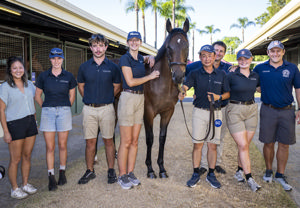
As I return from yet another visit to the QLD Magic Million sales, it occurred to me that it has been too long since I shared my insights as to what a new industry player should be mindful of, tax wise, before they commence a horse breeding and/or racing business.

Given January kicks off the major yearling and breeding stock sales, there is no shortage of enquiries during this period from people wanting to start a horse business so it’s a good time to revisit the major Frequently Asked Questions (FAQs) we receive on this topic.
The income tax and GST regime in Australia has, predictably, seen many changes since my last article on this topic, so I’m confident that I will cover off on the key areas you should be mindful of.
Q1. I’ve just bought a 1/6th share of a well-bred colt with some mates for $330,000 (inc.GST), does that make me a horse business? Can I claim back my $5,000 of GST paid?
Answer
Regrettably, no.
The ATO generally will not accept an interest in one or two racehorses as being an income tax ‘business’.
A stand-alone horse activity, without associated breeding activities, is rarely accepted as a business by the ATO, neither would this investment meet the GST ‘enterprise’ criteria, so the $5,000 GST could not be claimed back either.
Q2. I want to start a breeding business but want to do it by acquiring full or part interests in 3 or 4 quality yearling fillies first. Could I claim this as a horse business from the beginning?
Answer
Yes, possibly, if sufficient ‘business-like’ characteristics are in place from the beginning. These would include, but are not limited to:
- A business plan with projections;
- Proper record keeping, especially stock records;
- Use of consultants;
- Regularity and permanency of the activity;
- Profit intention;
- Activities must be systematic and organised and carried on in a manner consistent with ordinary trade in that industry
- Existence of a breeding property
- Breeding history of the owner;
- The breeding savvy of the owner; and
- Scale of investment.
Facts are always king in these cases, and if the purchaser does not ‘walk the talk’ and retire all or most of these fillies to the breeding barn, the ATO will have every right to strip such activity of its “business” status from the beginning.
Q3. My tax adviser has just told me that my new horse activity is an income tax “business”, so will the losses in the first few years be automatically deductible against my $500,000 CEO salary?
Answer
No, not unless the CEO applies for a private ruling under the ‘Non-Commercial Loss’ (NCL) rules which apply to individuals (alone or in partnership).
Under these NCL rules, where an individual earns an ‘adjusted taxable income’ of $250,000 or greater, the discretion of the ATO must be sought via a special private ruling to be allowed to immediately deduct the losses in the early years.
N.B. If the CEO’s salary was under $250,000, he or she need only meet one of four objective tests to be able to claim the losses.
Q4. I own a successful engineering business in a company, and I’ve just bought some costly horses in that same company, does this mean that the horses are also a ‘business’?
Answer
No, only if the horses are also a ‘business’ in their own right.
Merely because a company is carrying on a ‘business’ does not automatically mean its ‘non-horse’ activities, or any other activity that company conducts, will meet the same criteria.
In this instance, every effort must be made to prove that the horses are a business in their own right – a Business Plan supporting long-term profitability would be a very good start.
Q5. I’ve heard about these special mare ‘write-offs’, does this mean that all the mares in my horse breeding business, even those still racing, can use these rules?
Answer
No.
For a broodmare to be eligible for the ‘write-off’ rules, they must be:
- At least three years old;
- Acquired under a contract; and
- Must be used for breeding (i.e. not just capable of breeding).
For instance, the above rules would exclude:
- Horses bred by the owner that are later used for breeding (i.e. they are not acquired under a contract); and
- Mares that are still racing and not being ‘used’ for breeding.
Q6. Can I race the odd filly or colt/gelding that my breeding business has bred?
Answer
In most instances, yes.
The ATO will allow the racing of horses in a breeding business if the racing is an ‘integral’ part of the business, or in other words, is ancillary to the breeding purpose.
This means that horses bought to sale that did not attain a commercial price or a filly deliberately retained for the breeding herd, due to the quality of her pedigree and commercial appeal, will be allowed to be raced under the ‘integration’ principle.
N.B. If the racing of these horses is done for too long and/or too often, the ATO could question the overall ‘breeding’ status of your business.
Q7. Do I have to start a new company, trust etc to be able to set-up a horse business?
Answer
No.
A horse business can be run by you as the individual if it meets the ATO ‘business’ criteria. Setting up a new entity is not a significant ‘business’ factor.
However, if your major priority is asset protection, and a company or trust is appropriate to your current tax structure, serious consideration should be given to running your horse business through these structures.
An overarching request though; please set up your structure in consultation with your adviser or a firm with experience and capabilities in the horse industry. There is just too much ill-informed “pub-talk” out there as to the features and characteristics of the tax structure options.
Q8. My partner and I want a start a breeding business. Can we do it in partnership?
Answer
The very wide definition of ‘partnership’ in the Tax Act presents an opportunity to use a partnership structure for the splitting of family income.
The factors which the ATO considers when deciding whether persons (in particular spouses) are carrying on a business as partners include:
- The mutual assent and intention of the partners (essential but not sufficient);
- Joint ownership of business assets (to be reflected in accounts, too);
- Joint business account and the power to operate it;
- Extent to which parties are involved in the conduct of the business (e.g. one partner may have the horse savvy and contributes more capital, the other may handle administration and record keeping);
- Extent of capital contributions;
- Entitlement to a share of net profits (essential);
- Business records; and/or
- Trading in joint names and public recognition of the partnership.
The weight given to the factors listed above varies with the individual circumstances.
Q9. If I start a breeding business via buying mares ‘in-foal’, how do I value the ‘unborn’ foal in our closing stock?
Answer
The trading stock rules do not distinguish as to whether a mare is in-foal or otherwise on purchase, thus the total amount paid for the ‘package’ attaches to the mare only.
Thus, if a mare is acquired for $100,000 ‘in-foal’, her purchase price for tax purposes is $100,000. The foal, when born, is valued at $20 (if ‘cost’ method is used) or at a market selling value if that basis is used.
Q10. What is the tax treatment of my existing “hobby” stock if I want to start a breeding business?
Answer
The tax treatment of your existing stock depends on what entity owned the existing stock and whether you are wanting to trade your ‘business’ as an individual or via another entity (e.g. company or trust).
If the stock was originally owned by you as an individual ‘hobbyist’, and you want to convert to trading as a ‘business’ individual, the stock can be transferred to the new business at either cost or market selling value, however an appropriate election must be made pursuant to the trading stock tax provisions. Tax planning considerations will determine which valuation basis is used.
If the stock was originally owned by you as an individual ‘hobbyist’ and you want to trade as a ‘business’ within, say, a new company, this stock must be transferred to the new company at market value. In this scenario, consideration needs to be given as to the potential capital gain that may result on this transfer.
N.B. Under the CGT rules, an interest in a racehorse that costs $10,000 or less is exempt from CGT when sold or transferred.
If you wish for me to clarify or expand upon anything mentioned in this article, please do not hesitate to contact me.
PAUL CARRAZZO CA, CPA
Partner - Baumgartners
1/35 Cotham Rd, Kew, VIC, 3101
TEL: +61 3 9851 9000
MOB: 0417 549 347
E-mail: p.carrazzo@baumgartners.com.au